SCGP Newsroom

Fest Woodenware Cleanness, Safety & Environmental Sustainability

News

Fest Woodenware Cleanness, Safety & Environmental Sustainability

Loading Data...
“Spoon and Fork” are eating utensils for every meal. If we order takeaway food, such cutlery will also accompany our dishes to ensure our convenience. As green trends grow, people become increasingly aware of environmental issues. Wooden spoons and forks thus prove interesting alternatives to restaurants that want to position themselves as sustainability leaders.

Fest Woodenware is designed in 3 shapes and 3 styles under the concept International Cuisine that is different according to the eating culture of each nation, including China, Korea, and the West. Each nation has different styles of spoons, oranges, and knives that have different shapes and usage patterns. Fest is considered the leading manufacturer. The first and only one in Thailand that can produce wooden spoons, forks, and knives to comprehensively meet the needs of different uses.

Being supportive of farmers who can earn extra cash from growing trees in vacant land plots
Being made of fast-growing indigenous trees (3 – 5 years) from commercial forestry plantations, which are renewable
Being durable and suitable for all types of food
Being clean and safe, free from hazardous chemicals, and food-grade
Being friendly to the environment and 100% biodegradable
Being certified based on BRC Global Standard for Packaging and Packaging Materials
Being able to fit into many shapes with added value for brands
Accommodating optional logo printing and special-set services
Using modern manufacturing technology and compatibility with various types of wood
Having the capacity to produce 200 units/year

Related Contents

Loading Data...

“United Container” Drives Business with Technology and Environmental Care

News

“United Container” Drives Business with Technology and Environmental Care

“United Container” Drives Business with Technology and Environmental Care
Loading Data...

Successful business operations require considerations for society and communities to pave the way for happy co-existence. This is the work philosophy of Mr. Thatchai Piyakulchaidet, Managing Director of United Container Company Limited. His company therefore does much more than just delivering quality to customers.

Focus on Target Groups & Roar Ahead

United Container has evolved from a family business, established by Mr. Thatchai’s parents. Initially, the operation was based at the family’s home in Bangkok’s Lat Phrao – Bang Kapi area, was mostly manual, and staffed with just one worker. But the business grew over time. In 1992, it set up its current factory in Pathum Thani.

“We have mainly provided corrugated-paper packaging for niche markets. Our customers are those looking for high-quality packages and a reliable supplier such as exporters of processed foods, electronic parts, or auto parts. These target groups need durable packaging and punctual deliveries,” Mr. Thatchai explained.

“With clear focus, we have prepared our factory, machinery, and raw materials in response to customers’ needs. We think it is best to specialize to fully fulfill our target groups’ specific requirements. Through such approach, we have developed expertise and greater understanding of customers’ needs. That’s how our products and services serve our target groups best,” he continued.

Tech Update & People Capability Behind Product Quality

In the competitive business environment, a business will be sustainable only when it delivers quality and wins the hearts of customers. These two key elements exist where internal management is efficient.

“It’s a challenge to fulfill each of various orders – with diverse requirements – without any mistake. We have supplied custom-made packaging. So, most orders are different each day. It is also our duty to ensure timely deliveries. To exporters, delivery time is very important because container loading time is fixed. By addressing customers’ pain point, we give them peace of mind and time to focus on other aspects of their work,” Mr. Thatchai said.

“Not only that I have studied engineering and programming, but I have also had a passion for coding from a young age. During my childhood, my time at my dad’s factory showed me that software in fact could solve many problems and set up efficient work systems. United Container therefore has never stopped developing software and integrated information technology.

“We have built our business sustainability by keeping pace with technology and developing new software for use at our company. Thanks to such efforts, we can reduce the risk of problems and dependence on specific staff’s expertise. For example, our factory has a real-time output recording system. Our staff therefore do not need to key in information manually. The system records everything from the start and end of production time, volume produced, downtime records, and production speed. Data automatically recorded by our computer system are then analyzed in support of production/productivity improvement or waste reduction,” he added.

“Our machines and technologies have been regularly updated. On top of that, we have used quality raw materials only. Our good standards, waste reduction, efficiency improvement, and cost reduction all have contributed to our competitiveness,” he continued.

“At the heart of our business operations are our staff. We believe in good governance and employee care. We have implemented several policies to improve employees’ welfare and quality of life because we believe that our employees’ happiness is translated into good output”.

Sustainable Environmental Care

“We have placed a strong emphasis on environmental care because we think our business should coexist with communities and the environment. Our environmental care is greater than what is required by laws, with regular reviews in place. We have even imported a wastewater treatment system for 100% water recycling. Our factory therefore does not discharge a single drop of wastewater to local communities,” Mr. Thatchai pointed out.

“We have also recycled paper in collaboration with SCGP. We have gathered, compressed, and sent our paper scrap to SCGP out of trust that SCGP will handle it properly. Regarding other types of industrial waste, we have complied with laws. It is buried at an authorized landfill. In our view, mutual coexistence with communities is crucial to business sustainability.

“In addition, we have installed full-scale solar cells to generate power for our factory. On a sunny day, we hardly need power from an electricity authority. Our solar installations help curb environmental impacts as well as our production costs, which will also benefit our customers,” he continued.

Collaborating with Quality Partners

“We have chosen SCGP as our partner because of the latter’s solid quality policy. SCGP is very reliable and supports us strategically. United Container focuses on exporters and suppliers of premium products. Our customers therefore have high expectations. Packaging used for them must be exceptionally durable and delivered through a reliable supply system. SCGP perfectly answers our needs.

“Aside, we have braved through several crises with SCGP by our side before. A few years ago, a paper shortage crisis occurred but we had hardly felt any pinches because SCGP took good care of us. When the global market turned highly volatile, SCGP also helped ensure that pricing for us was still reasonable and enabled us to remain competitive. As we produce packaging at reasonable costs, our customers can compete well in their market too. SCGP has always taken good care of us. So, we really are looking forward to growing alongside SCGP in all years to come,” Mr. Thatchai concluded.

Related Contents

Loading Data...

Turning Your Passion into Values

News

Turning Your Passion into Values

SCGP TEAM
Loading Data...
With technology’s growing presence in our organization, our employees need to learn more about tech solutions for efficient applications. In this volume, four employees shared their perspectives with a LOT after they jointly developed an AI-enabled integrated wood management system – one of SCGP’s key projects.

“I am in charge of paper-pulp production. But basically, I am passionate about Data Science, Machine Learning, and AI. I thus always think of how to use my passion for my company. Thanks to our supportive work environment, my initiative could take off. Colleagues are open-minded. Communications are fast and I have fun working.

“In the past, our staff measured wood logs onsite to get raw materials. But now, we use AI for measurement. It is possible because my team and forestry unit supported my idea of AI application. This AI solution works well for us, farmers, as well as the environment in the long run because it ensures quality materials for our plant and proper pay for sellers. Farmers naturally pay more attention to their forest plantations for compliance with our AI-enabled measurement system’s criteria.”

Nattavut Mekmok

TPC Pulp Production Department Manager, TPC

“I have long studied and developed data-science models. So, I always look for ways to apply data science to my job. As SCGP encourages innovations and offers learning opportunities, I get access to a sandbox and a reasonable budget to experiment with my ideas.

“This project integrates Computer Vision. With the help of CCTV, images are streamed into my model that accurately detects a targeted log and measures its size. The big challenge of this project is quality image enhancement, as we need to train the model and constantly improve its accuracy. Quality is important because the model is really used to facilitate operations and determine money issues for both internal and external parties. My model was simple. I developed it and conducted the proof of concept with my computer. Initially, I just checked if the model could detect a log. Then, I developed it further and further until this project kicked off. I am so proud. I am determined to develop it further.”

Phiphatsak Thairatana

Supply Chain Analyst – SCGP

“It’s quite a challenge to persuade our partners to try and accept our new log measurement system. We have convinced them by showing a comparison between the old and the new systems. We underline accuracy and communicate to boost farmers’ understanding.

“To me, SCGP is like a big school. It has taught me many things, including hard skills and soft skills. I now believe in the value of others. With mutual respect, I work happily every day.”

Fontip Sornsurad

Raw Material and Warehouse Section Manager – TPC Pulp

“SCGP has prepared formal and informal communication channels for us to express our opinions and receive advice. So, I have the courage to propose new ideas. Importantly, because all staff are capable, we can learn from one another. As we have shared our perspectives, we have seen the same goal and driven our organization forward together.

“I think trust from colleagues, customers, and suppliers comes from how we have treated others. When we deliver good things and solutions, we automatically win trust and credibility.

Siwarak Butdee

Value Chain analyst, SCGP

Related Contents

Loading Data...

Deltalab receives Best Channel Partner Southern Europe 2023 Award Strengthening the Healthcare Supplies Business

News

Deltalab receives Best Channel Partner Southern Europe 2023 Award Strengthening the Healthcare Supplies Business

Previous slide
Next slide
Loading Data...

Dr. Pongsuda Pongtanya, Managing Director, Mr. Angel Abellán National Sale Director – Industry Division, Mr. Mario Muñoz Strategy, Business & Product Development Director and Mr. Guillermo Hernández Product Specialist & Sale represented the Deltalab, S.L. (Deltalab) team received the Best Channel Partner Southern Europe 2023 award: Food Science Division at the EMEA Channel Partner Meeting 2024 held on 20-21 March 2024 at the Bio-Rad Office, Institut Pasteur in Paris, France.

In the past year, Deltalab has achieved outstanding performanceas a distributor of Bio-Rad products in Southern Europe in both sales and growth rate. Bio-Rad is a global company with wide ranges of reagents, equipment and various test kits in Healthcare, Life Science, and Food Industry. As a result, Bio-Rad and Deltalab are ready to expand business cooperation and have planned for continuing growth together.

During the event, the Deltalab team presented and exchanged knowledge on 2 topics: “Strengthen our Business & Partnership: Bio-Rad & Deltalab” by Dr. Pongsuda Pongtanya and “Success case in offering sales and installation, IQ-Check Prep tool for a large customer in Spain” by Mr. Guillermo Hernández Additionally, they met with distributors from various countries to update technological knowledge and new products for further industrial development in the future.

Related Contents

Loading Data...

Digital Partner of the New Generation

News

Digital Partner of the New Generation

Loading Data...
Today, digital technology and artificial intelligence (AI) have played a role in several organizations. The way of working therefore has changed. These innovations, for example, have already helped with rewriting articles, diagnosing diseases, and improving customer service.

The human race started watching AI development with concern, though, out of fear that AI may steal jobs from many people in the end. However, human users of AI usually realize that this technology offers what humans lack. So, in fact, AI can work alongside humans to drive business growth.

Effective AI application requires three main components: humans who develop and leverage AI capabilities, AI that is designed to support humans’ work, and adaptation-ready organizations.

“Digital Partners” Empower Working People

A study by Harvard University shows more than 1,500 companies have achieved better performance after integrating AI into work process. Organizations and people thus should support the appropriate use of AI, which can serve as “digital partners”. Greater efficiency and fruitful collaboration can happen when:

Human: AI should be trained in human thinking process so as to ensure they can act and feel just like humans.
AI: AI should raise its analytical and decision-making capabilities. Backed by information, it then can prevent problems and interact better with customers. As customer experience improves, so do brand and product image. Organizations will answer their target groups better too.
Organizations: Organizations should be flexible. They should fast adjust plans in response to changing contexts, with an open mind and integration of technology for human workforce’s capability improvement.
ChatGPT, Gemini, Jasper, and Quillbot are examples of how AI can enhance work efficiency, and so are robots and autonomous systems for production lines and service delivery. AI also supports Quantum Computing as well as Green & Sustainable Technology.

Other digital technologies, such as the Internet of Things (IoT), Data Science, Virtual Reality (VR), and Cloud Computing, are also helpful. With Machine Learning, AI hones its analytical thinking, creativity, complex problem solving, and even emotional intelligence. Coupled with Computer Vision, AI understands images and VDO. To work alongside AI, humans therefore must learn and understand these things as well.

As working people in the new era, we need to look at AI and digital technologies from a new perspective. We should see them as digital partners that will lower our digital debts. With them by our side, we can focus on other aspects of work, retain our creativity, and uphold our work efficiency. AI, the Digital Partner, promises to bring humans’ performance to the next level.

source: A LOT Vol.33

Related Contents

Loading Data...

Service Mind + Tech to Impress Digital-Age Customers

News

Select Service Mind + Tech to Impress Digital-Age Customers

Select Service Mind + Tech to Impress Digital-Age Customers Service Mind + Tech to Impress Digital-Age Customers
Loading Data...

As digital trends have been growing in society, enterprises as well as employees face the challenge of keeping pace with rapid changes. a LOT’s interview with Mrs. Jindapa “Aor” Preechayangkoon, Customer Services Director of SCGP, reveals how our company has served our customers over time. Mrs. Jindapa used to visit customers at home before the company launched SCGP Contact Center. Today, it has even integrated AI (artificial intelligence).

Product Changes in Response to Digital Trends

After receiving a master of business administration and marketing, Mrs. Jindapa joined SCGP as a market researcher. Based at the Planning Office, she learned about every product of the company and gathered customer insights via market surveys / research. She was later appointed the Planning and Market Analysis Manager at Siam Kraft Industry Company Limited. After her stint there, she returned to SCGP as its Marketing Services Manager. With further promotion, her current position is Customer Services Director.

“I am now in charge of managing customers’ purchase orders. I am also planning products to ensure they match customers’ needs. Product planning requires coordination with the production planning unit and all units related to selling platforms. I have even dealt with Strategic Supply Chain, Advanced Data Science, and Information Technology in support of SCGP’s plan to fast handle purchase orders from digital-age customers for proper product delivery.

“The arrival of digital trends seriously affected our businesses in the beginning as it curbed paper demand. Noticing the trends, we developed new products like food-grade paper and foodservice packaging. We have even created new distribution channels to enhance access to consumers. Our customer base therefore has expanded from B2B to B2C. Today, we have operated online and e-Commerce channels, which are parts of our digital transformation.”

Reading Customers’ Mind with AI for Fast & Efficient Services

“The number of our customers has now increased through B2B, B2B2C, B2C, Retail Sales, and e-Commerce sectors. Purchase orders get smaller and more diverse, though. So, our selling system must be able to serve various groups of customers efficiently and fast. Our backdoor system must enable us to see the status of progress for each purchase order–from the production process to the delivery to customers.

“In my view, AI usage will increase. It will help more with Robotic Process Automation (RPA) and Optical Characteristic Recognition (OCR), which transforms images into text. Through such applications, workloads on human staff reduce and so does the risk of errors related to repetitive tasks. Jobs can also be done faster, paving the way for human staff to focus better on strategic and creative thinking. Backed by AI, chatbot not only supports customers’ product searches and answers their simple questions. We expect AI to become more sophisticated and more understanding of customers’ needs. Customized analytics and communications will be possible with Humanized Chatbot (ML/AI), which promise to not just ease human staff’s workload further but also respond faster and better to customers’ needs.

“Although digital technology has increased work efficiency, it won’t replace humans. It can’t compare to humans in terms of complex problem solving and ability to create customer satisfaction. AI only helps support customer services via data analytics. So, its integration into work process will satisfy customers and strengthen our customer relationships.”

Move Faster Than Changing World

“SCGP has set up Technology and Digital Platform (TDP) team to support work systems as we have adapted to the changing world. In addition, we have constantly upskilled and reskilled our staff. Our employees are expected to keep pace with evolving technologies including so that they can apply tech solutions for their work and organization.

“It is important to communicate with employees to boost their understanding of how crucial digital technology is for enhanced efficiency. We must encourage employees to participate in the improvement process. We need to nudge them to share ideas and experiences. We must learn and act together while embracing a customer or consumer-centric approach.

“My life / work philosophy is that one must keep learning because the world is always evolving. We must stay one step ahead or at least keep pace with what has been happening. Trials may go wrong but we can learn from mistake. We must be resilient and adaptive. We should try adjusting the work approach to simplify tasks. Let’s look for a Lean Process and upgrade efficiency further. Have trust in our team and support one another. Together, we can drive our organization ahead.”

Related Contents

Loading Data...

“Market-Led and Innovation-Driven”, “Creating Sustainable Income Opportunities with Fast-growing Economic Trees”

News

"Market-Led and Innovation-Driven", “Creating Sustainable Income Opportunities with Fast-growing Economic Trees”

Previous slide
Next slide
Loading Data...

At the recent academic seminar titled “Market-Led and Innovation-Driven for Income Growth Through Fast-growing Economic Trees” held at the Faculty of Forestry, Kasetsart University, the network involved in the cultivation and management of fast-growing economic trees unanimously agreed that “fast-growing economic trees” (with a harvesting cycle of no more than 7 years and a growth rate of over 1.5 centimeters in diameter per year) are still filled with benefits and opportunities to generate income for the growers. Most of these growers are small-scale farmers and individuals in the supply chain. This is due to the high domestic and international market demand, especially the current trend of processing them into “eco-friendly products” as alternatives to plastics derived from fossil fuels. This aligns with the megatrend of reducing global warming, which will change consumer behavior and global trade rules to be more environmentally friendly.

However, to achieve success in these initiatives, employing “Market-led” and “Innovation-driven” strategies is necessary. This means cultivating fast-growing economic trees that meet current and future market demands by incorporating technology and innovation to enhance efficiency, reduce costs, and increase per-rai yield to meet market quality requirements. This is particularly true for eucalyptus and rubber trees, the two fast-growing economic trees currently driving Thailand’s fast-growing economic tree market, resulting in a higher “return on investment.” As farmers’ incomes increase, there is a motivation to expand the planting area from the current area of no more than 5 million rai, leading to “sustained investment in the industry.”

Mahasan Thieravarut, Managing Director of Siam Forestry Company Limited, a subsidiary of SCGP, which promotes the planting of eucalyptus under the “Khu Din by SCGP” brand, highlights the potential of fast-growing economic trees, noting the increasingly diverse uses of such trees in the current market. These trees are being developed into products used in daily life, especially in Europe, such as wooden cultlery; clothing produced from wood pulp; water bottles made from wood pulp as an alternative to PET plastic bottles; and roofing materials utilizing wood pulp (wood for construction), including wood pulp as an ingredient in medicine production. Furthermore, there is a trend towards developing other “Bio-based” products, contributing to an ongoing reduction in carbon dioxide emissions.

“In the past, our company has worked on developing plant species and has encouraged small-scale farmers to plant saplings before buying them back to bring into our pulp plants within the group. We see that eucalyptus is a leading fast-growing economic tree in Thailand. However, a challenge is that these trees are not planted in large plots. About 70-80% of the land is grown by small-scale farmers in areas of 5-10 rai, posing a challenge to expand the planting area into large plots of 50 rai to achieve economies of scale.”

In addition, the seminar noted that the government and relevant sectors must collaborate more in “promoting the planting of fast-growing economic trees” to meet the increasing future demand for their use. This includes designating zoning areas for the utilization of land for planting fast-growing economic trees, enacting laws to support greater use of wood products, such as tax reductions or other incentives, creating awareness and understanding of the benefits of planting fast-growing economic trees that using wood products does not destroy forests but rather helps increase them (the more we use, the more we plant), fostering collaboration in developing species together with the government, and pushing projects for planting fast-growing economic trees along with other economic plants (agroforestry) to maximize the benefits of land use, providing farmers with additional income while waiting for the fast-growing economic trees to reach the harvest cycle.
Pramuan Pratoom, an advisor to Siam Tree Development Company Limited, said that eucalyptus still has a distinct market but requires good management to increase per rai yield and must develop diverse uses to increase the wood’s value.

“Some people say eucalyptus has no future, which is not true. It’s more about how the area is managed. Do not view eucalyptus negatively when, in reality, it helps create jobs and generate income. We need to shift our perspective towards better management. The overall use of eucalyptus in Thailand is at 5-6 million tons per year, with exports to Japan, China, Taiwan, and Indonesia. In 2023, exports amounted to 5.17 million tons.”

Wattanapong Thongsoi, a representative of the Thai Biomass Trade Association, shared insights on the energy wood situation, saying that in the long term, the energy wood market in Thailand, which currently consists of more than 50% rubberwood, will be driven by the goal of carbon neutrality and achieving net-zero greenhouse gas emissions. These global goals aim to reduce the use of fossil fuels, presenting an opportunity to expand the energy wood market. Thailand has a strong position due to its abundant raw materials and tropical location, facilitating rapid tree growth.
However, it is necessary to have good planting and marketing management by cultivating large plots, which can lead to a maximum investment return of up to 20%. Development should occur simultaneously among growers, processors, and exporters. At the same time, products must be diversified, and research should be expanded in more dimensions, such as logistics.

Samran Hantaley, CEO of Kitti Wana Group, believes that the planting of fast-growing economic trees creates opportunities, jobs, and income for farmers and leads to an increase in diverse industries related to wood. Additionally, he observed the continuous development of eucalyptus species, which has led to an increase in yield per rai to 20-25 tons within a 4.5-year growth period, compared to the original eucalyptus species (seed propagation), which yields only 8-10 tons per rai but takes 8-10 years to grow. Therefore, species that meet market demand are something that those in this industry must not overlook.

Prachak Ruenrit, a representative from SilviCarbon Agroforestry Company Limited, said that the cultivation of fast-growing economic trees suitable for growers and processors requires the use of innovations, such as species improvement and selection, sapling production, planting and maintenance, utilization of wood, marketing, and finance. Continuous development in all these areas is essential.
Associate Professor Dr. Nopparat Kaakkurivaara, a lecturer of the Department of Forestry Engineering at the Faculty of Forestry, Kasetsart University, believes that technology used in the cultivation and management of fast-growing economic trees must address the needs of the growers. With over 70% of Thailand’s fast-growing economic tree growers being small-scale farmers, technology must be accessible, user-friendly, compact, easily transportable, and affordable. This is essential to promote the widespread application of technology in managing fast-growing economic forests.

Natnarong Iammee, manager of Tree Technology Company Limited, suggested that planting eucalyptus on ridges between paddies can enhance land utilization efficiency and increase income for farmers. Many ridges, currently left unused, can be modified to be 1.5-3 meters wide, and if fast-growing economic trees are planted on these ridges—80-200 trees per rai—within 6 years, farmers could generate an income of 24,000-40,000 baht per rai. However, proper care and management are necessary to achieve the quality demanded by the market. Therefore, policy support from the government is seen as crucial, such as financial support and the provision of knowledge on managing fast-growing economic trees to maximize benefits.

All of this reflects the potential of fast-growing economic trees from the perspective of distinguished speakers from the network of cultivation and management of fast-growing economic trees. They all see the “opportunity” in developing fast-growing economic trees in terms of expanding the planting area into larger plots, utilizing market-led and innovation-driven strategies to make fast-growing economic trees a more significant driver of the economy in the future.

Related Contents

Loading Data...

SCGP Announces Q1/2024 Operating Results with Profit of Baht 1,725 Million, Driving Strategy for Quality Growth

News

SCGP Announces Q1/2024 Operating Results with Profit of Baht 1,725 Million, Driving Strategy for Quality Growth

Previous slide
Next slide
Loading Data...

SCGP announced its Q1/2024 operating results, with total revenue from sales of Baht 33,948 million, marking a 1% growth, and profit of Baht 1,725 million, surging by 41% compared to the same period of last year. This growth was fueled by improved production efficiency, effective cost management, product portfolio alignment with market dynamics, and increased sales volume. SCGP is set to foster further growth with investments in M&P, packaging solutions innovation, and continuous improvement in production efficiency.

Wichan Jitpukdee, Chief Executive Officer of SCG Packaging Public Company Limited or SCGP, said that overall packaging industry in ASEAN continues its steady recovery, propelled by favorable economic factors, manufacturing sector growth, improvement in exports, and Thailand’s thriving tourism. These have led to increased usage of packaging across industries. For the integrated packaging business, sales volumes have surged across all product categories. Meanwhile, further signs of recovery are emerging for durable goods packaging such as apparel and footwear, thanks to decelerating global inflation. In addition, the packaging paper industry has seen a boost in demand both domestically and for exports to certain areas, particularly South Asian countries, while the fibrous business has experienced increased sales of foodservice packaging amidst recovery of tourism. Nonetheless, there were seasonal effects from the Lunar New Year holiday in China and Vietnam, and soft demand in the automotive segment during this quarter. On cost side, raw materials costs have been gradually increasing in line with the rise of packaging demand. Energy cost was moving sideways while freight cost went up at the beginning of the year amid geopolitical issues in the Middle East and started to subside in latter part of the quarter. Amidst abovementioned factors, SCGP has demonstrated resiliency while adjusted the product portfolios to align with market situations and capitalized on opportunities to effectively sustain the strategic supply chains.

In Q1/2024, revenue from sales amounted to Baht 33,948 million, up by 1% YoY, driven by improved sales volumes across both integrated packaging business and fibrous business. EBITDA reached Baht 5,151 million, marking a 15% increase YoY, while the profit for the period surged to Baht 1,725 million, up by 41% YoY. These results stem from strategic growth initiatives, continuous improvement in production efficiency to reduce costs through Machine Learning and the application of Artificial Intelligence (AI) in packaging paper production, and efficient management of recovered paper sources in the region, amidst rising raw material prices, through a diversified network covering Thailand, Vietnam, the Philippines, and Indonesia, totaling 155 locations (doubled in number in the past three years).

SCGP has allocated a budget of Baht 10,000 million for Merger & Partnership (M&P) investments in high-growth potential sectors such as consumer packaging, fiber packaging, healthcare-related businesses, and medical supplies & labware for packaging demand that is expected to continue improving due to the positive development in manufacturing sector and export performance. This is part of the total CAPEX budget for this year amounting to Baht 15,000 million. On M&Ps, negotiations are currently progressing well, with expected conclusion in certain deals within this year.

For growth through production capacity expansion, in March, SCGP has successfully completed its organic expansion of corrugated containers production capacity in Samutsakorn and Samutprakan provinces. This project adds 75,000 tons per year, which is equal to 9% of the total production capacity in Thailand. The project utilizes modern production and printing technologies such as robotics, automation, and printing applications. The new production base is strategically located close to the export-oriented frozen product manufacturing hub, enabling the company to better accommodate and meet customers’ needs while enhancing cost competitiveness in transportation.

SCGP continues to innovate its packaging to meet customers’ demand and strategizes to enhance production efficiency to cope with volatility in raw material and energy prices. The implementations of Machine Learning and Artificial Intelligence (AI) in packaging paper production processes are being rolled-out further to plants in Indonesia and Vietnam. Furthermore, efficient utilization of resources is under focused along with the continuous reduction of net greenhouse gas emissions to zero (Net Zero) by 2050, in line with ESG framework.

SCGP has also recently received an ESG performance evaluation score of 85 from S&P Global Corporate Sustainability Assessment (CSA), maintaining its position within the top 1% globally for the second consecutive year. This recognition stems from resolute commitment to conducting business sustainably. Additionally, SCGP was honored with Best Green Loan award in Sustainable Finance category at The Asset Triple A Awards 2024 by The Asset, a leading finance magazine in Asia. This accolade was received for Green Loan, with support from Bank of Ayudhya Public Company Limited, that will be used in investment in environmental projects in line with ESG Framework.

Related Contents

Loading Data...

SCGP joins hands with Thai Beverage Recycle, Bringing used paper back to recycle, creating more value according to the Circular Economy principles

News

SCGP joins hands with Thai Beverage Recycle, Bringing used paper back to recycle, creating more value according to the Circular Economy principles

Previous slide
Next slide
Loading Data...

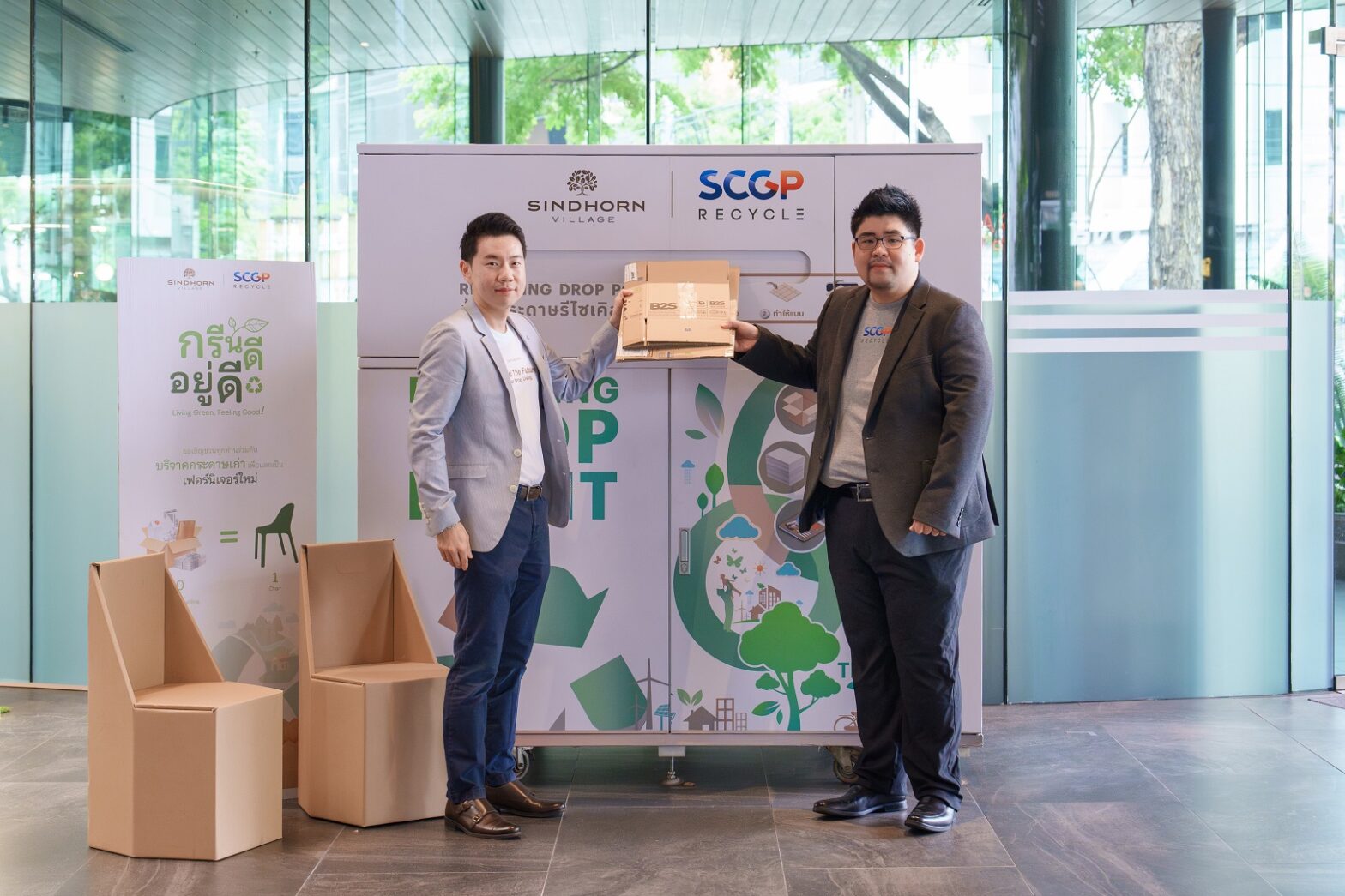
SCGP, led by Mr. Peeraphong Thepwarintr, Manager – Recycling Solutions (Acting Director – Recycling Materials Management), and Thai Beverage Recycling Co., Ltd. or TBR, represented by Mr. Boonanake Wannapanich, Assistant Managing Director, signed a memorandum of understanding (MOU) on “Taking back used paper packaging and recycling them systematically to sustainably conserve the environment.” on March 15, 2024 at Lao Peng Nguan Building, 32nd floor. SCGP will bring TBR’s used paper packaging materials back into the entire production process.

This cooperation shows the trust from TBR, one of the business leaders in post-consumer packaging management in Thailand, in having SCGP co-manage the collection of paper packaging for recycling correctly and efficiently. SCGP continues to build collaboration as well as continuously creates innovations that better meet the needs of customers and consumers. We pay attention to the maximum use resources according to the Circular Economy principles and adopting digital technologies to the work in the organization. This will help improve operational processes throughout the value chain to bring about the business growth and sustainability for all stakeholders.

Related Contents

Loading Data...

SCGP collaborates with the Royal Thai Embassy in Dakar, Foster Business Ties between Thailand and Senegal, Empowering Business Leaders with Packaging Expertise and Highlighting Thai Private Sector’s Potential

News

SCGP collaborates with the Royal Thai Embassy in Dakar, Foster Business Ties between Thailand and Senegal, Empowering Business Leaders with Packaging Expertise and Highlighting Thai Private Sector's Potential

SCGP ร่วมกับ สถานเอกอัครราชทูต
Loading Data...

Last March, SCGP, in collaboration with the Royal Thai Embassy in Dakar, welcomed 20 Senegalese and Gambian businessmen who were interested in a study tour and the packaging business negotiation. Mrs. Juthamart Sayampol, Manager – Creative Design Management- Inspired Studio and Packaging Solutions, SCGP, was a business lecturer at this event and provided basic knowledge about packaging solutions, and the potential of SCGP for the growth needs of the international market.

“Senegal is an emerging country with great potential. Economically, it is a developing country that has a large number of agricultural products. Therefore, SCGP’s packaging innovation is needed. This is an opportunity for both Senegal and Thailand to increase trade and investment with each other,” said Ms. Papada Pakdethanakul, Second Secretary, Royal Thai Embassy in Dakar.

“The innovations presented in this SCGP Inspired Solutions Studio have many benefits for the sustainability of the Senegalese market. It also helps reduce the impact on the environment. We like it and are very impressed, especially with foodservice packaging which is in great demand in our country. The packaging solutions will help us be more accessible and healthier. What also impressed me was SCGP’s packaging paper recycling and reusing system,” stated Mr. Abdourahman Jallow, CEO – Afro Express, Gambia.

Related Contents

Loading Data...