
Loading Data...
661
Spotlight
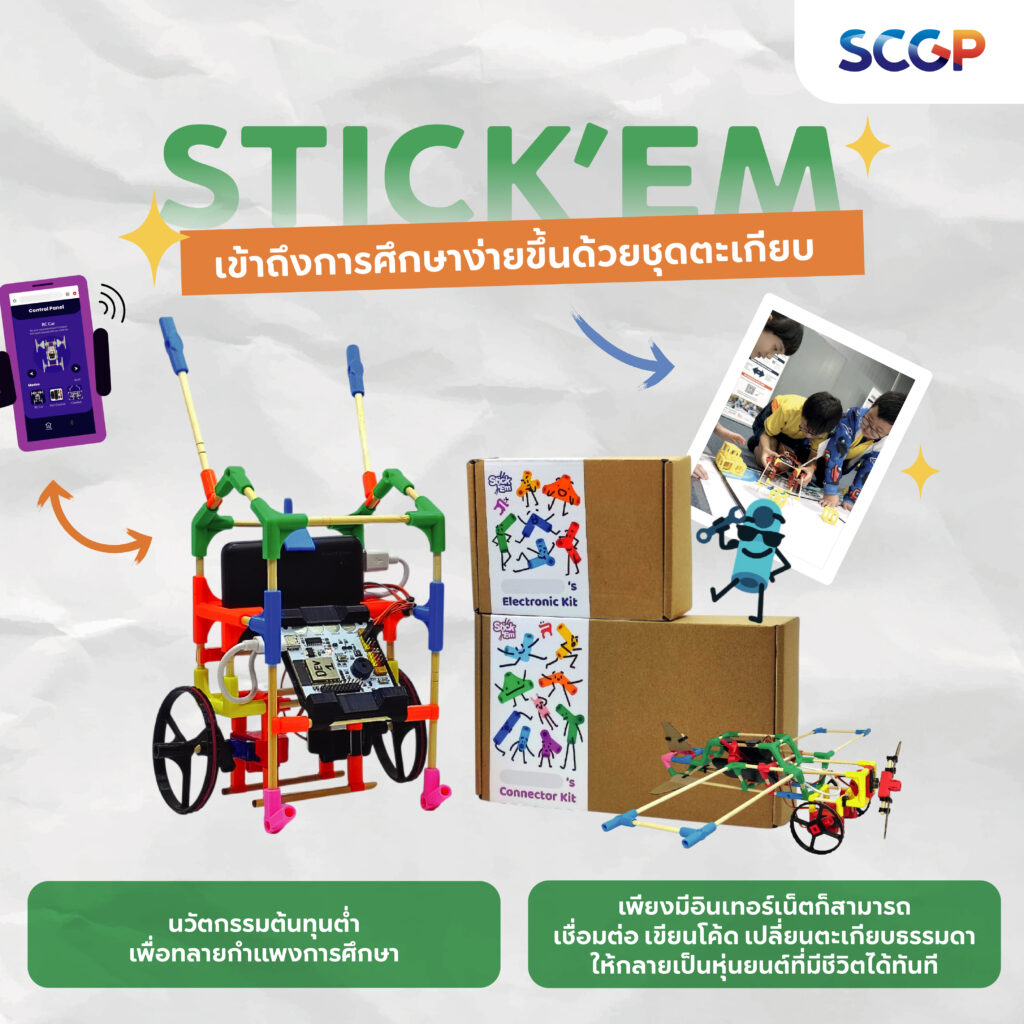
Stick’Em Makes Education More Accessible with a Set of Chopsticks
Loading Data...
In the age of AI, STEAM (Science, Technology, Engineering, Art, and Mathematics) skills are at the heart of learning. Yet more than 90 percent of the world’s population, or nearly one billion people, lack access to quality STEAM education.
Students’ Idea for Every Learner
Stick’Em is a Singaporean education tech startup. It was established after four 17-year-old students, with their inspiring experience as robotics trainers and STEAM instructors, decided to make a difference. Recognizing that traditional education models did not effectively support learning, these young entrepreneurs dedicated five years—while studying at university—to fundraising, designing, and developing Stick’Em and its low-cost STEAM learning innovation.
A Stick’Em kit consists of two main components: a construction set featuring items such as bamboo chopsticks, wheels, rubber bands, and 3D-printed connectors; and a basic electronics set, including circuit boards, motors, and power banks. These widely available and affordable materials keep the price of each Stick’Em kit at just USD 100, about 10 times cheaper than comparable learning kits on the market.
Affordable & Sustainable Advanced Learning
On top of featuring affordable, low-cost, and replaceable parts, Stick’Em has two competitive advantages that allow it to create a broad and lasting impact on STEAM education. Firstly, its flexible lesson platform is compatible with all types of infrastructure. Whether a school uses computers, tablets, or smartphones, as long as there is internet access, students can connect, write code, and instantly transform ordinary chopsticks into robots. Secondly, its teacher training model is easy-to-understand, empowering teachers for any subject areas to confidently teach STEAM.
Currently, Stick’Em innovation has been widely adopted. It has already made its way into 27 state schools in Singapore and more than 90 overseas schools, covering over 12,000 students. This tech startup has generated revenue from not just one-time equipment purchases but also recurring platform fees. In 2025, Stick’Em won first place at the Hult Prize 2025, the world’s largest social business plan competition for university students—securing a USD 1 million prize.
Stick’Em success proves that a business can create both social impact and economic value, and quality education can in fact, be provided at a low cost. With Stick’Em, everyone can enjoy equal access to future skills.
Source: a LOT Newsletter Vol.38