
Loading Data...
1,208
P-DNA
EMPOWER TEAM & HEAD TOWARDS SHARED GOALS
Loading Data...
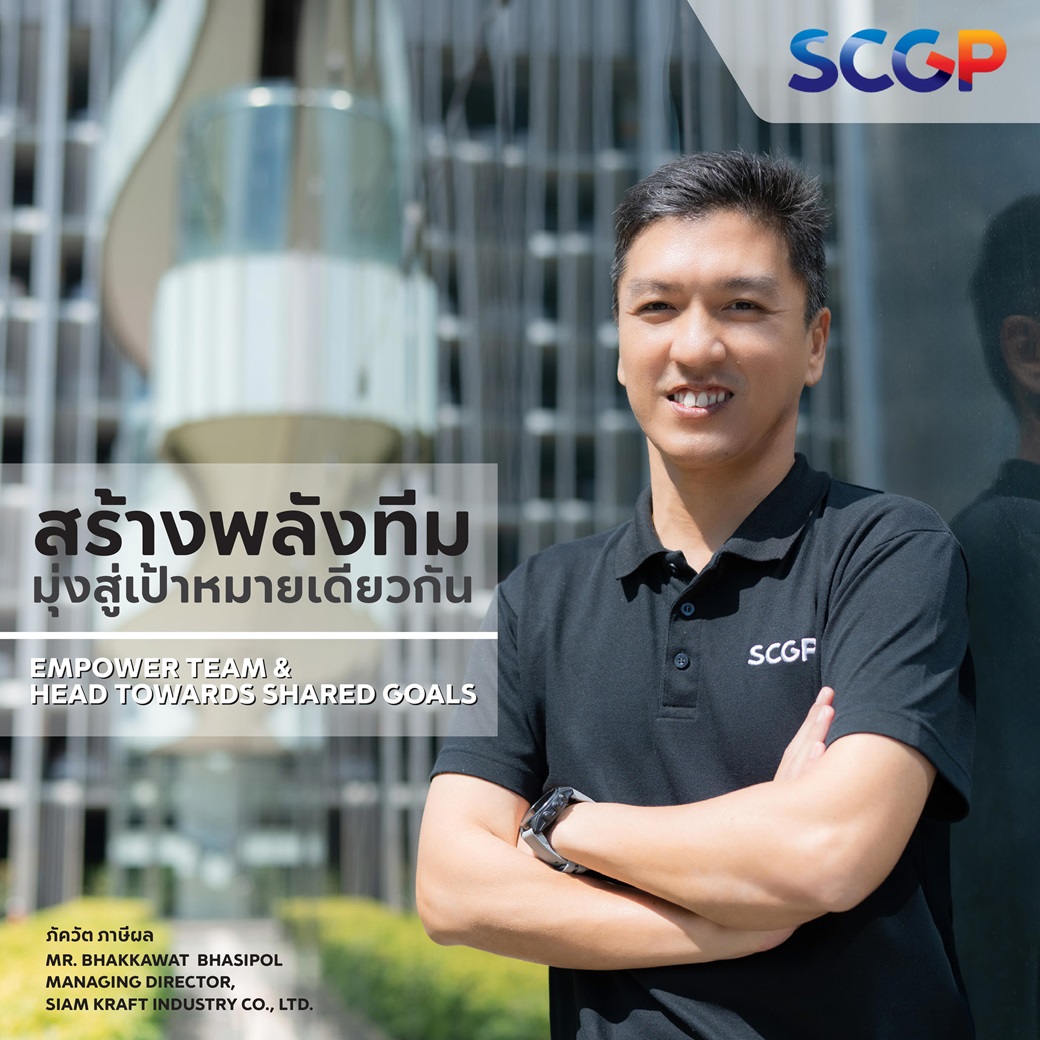
In today’s complex and rapidly changing business world, seamless collaboration is the key to unlocking excellence. In this issue, we sat down with Mr. Bhakkawat Bhasipol, Managing Director, Siam Kraft Industry Co., Ltd., to find out how this new-generation executive has fostered seamless teamwork for the company’s sustainable growth throughout the past few decades.
20 YEARS OF ADAPTATION OPPORTUNITIES
Mr. Bhakkawat started working for the company in 2000 as a plant engineer and later received a company scholarship to pursue an MBA overseas. After he returned to Thailand, he took on a wide range of challenging roles, from business planning and international sales to sourcing management and corporate-level strategic planning.
“The major turning point in my life was my transfer from the international sales field during the Hamburger Crisis. Back then, domestic demand faltered, and we had no other choice but to tap into overseas markets,” he recounted.
“I was really worried because with my engineering background, I was never a salesman. But over time, I had learned to apply my experience to my new role. Data analyses were made to assess the demand/supply of each target country. Digging deeper then revealed new opportunities. I have eventually realized that there is no task we could not accomplish, as long as we apply what we have.”
CHANGE & GROW TOGETHER
In a high-level executive position, Mr. Bhakkawat not only takes on more responsibilities but also adjusts his mindset toward people management.
“I used to think we couldn’t change others. We could only change ourselves. However, while studying in the Advanced Management Program, my executive coach explained that my beliefs were just partly true. With coaching, coachees can develop. If I were to stick to my old beliefs, it would mean coaching was meaningless. It is necessary to understand that people can change and improve,” he interestingly shared his experience on this shift in thinking.
“From that time on, I no longer focus solely on changing myself. I communicate and coach to help others develop their potential and fine-tune for smooth collaborations.”
SEAMLESS COLLABORATION BEGINS WITH PURPOSE
“In large organizations, conflicts naturally arise. The production team wants big production volumes, while the sales team wants the best products at the lowest cost. Each team has its own KPIs. So, we need to step back and look at the bigger picture like our organization’s purpose. For example, SCGP’s goal is to make the world a better place. If everyone, regardless of department, shares the same vision, their smaller goals can be adjusted and aligned in the same direction,” he continued.
COMMUNICATION FOR MUTUAL UNDERSTANDING
Mr. Bhakkawat also shared a real case about a customer’s demand for a special-grade product requiring extremely high cleanliness standards.
“After listening to the customer’s brief, the quality management team interpreted it as the requirement for 10-PPM (parts per million) cleanliness. That would mean the manufacturing team would need special raw materials and more time, resulting in higher costs.
“We then decided to double-check with our customers and all relevant staff, which enabled us to find out that the customer was fine with the 400 PPM. So, we could produce products for our customers without the need to use special raw materials or production processes. This case makes clear that we should communicate and connect with the customer for the best solutions.”
BRIDGING THE GAP FOR POWERFUL TEAMWORK
In the eyes of Mr. Bhakkawat, the age gap within the workforce presents opportunities.
“I am on the border between Gen X and Gen Y. But now, more Gen Zers have joined the workforce. In this multigenerational context, it is important to be understanding. Older staff should be open to the younger staff’s perspectives and knowledge, while the juniors should learn from the seniors’ experience and prudence. If we combine the strengths of different generations in our corporate culture of Customer and Consumer Centricity, Seamless Collaboration, Proactive & Agile, Inspiration & Innovation, our organization will enjoy solid growth, and we all will be happy at work.”
For personal development and professional success, Mr. Bhakkawat recommends his long-held 4D principles:
- Discipline
Considered the foundation of everything, discipline starts with small actions such as being punctual and keeping one’s word. These characteristics are essential to professionalism.
- Decisiveness
Leaders have a duty to make decisions. A team cannot move forward if its leader does not take a clear stand, and decisions must be made based on facts and data.
- Development
The world evolves so fast that today’s knowledge may no longer be relevant tomorrow. So, keep learning and take good care of our health.
- Dedication
Build the next generation. Be open to the fact that younger people are tech-savvier and understand new-age consumers better. Our role is to help them grow.