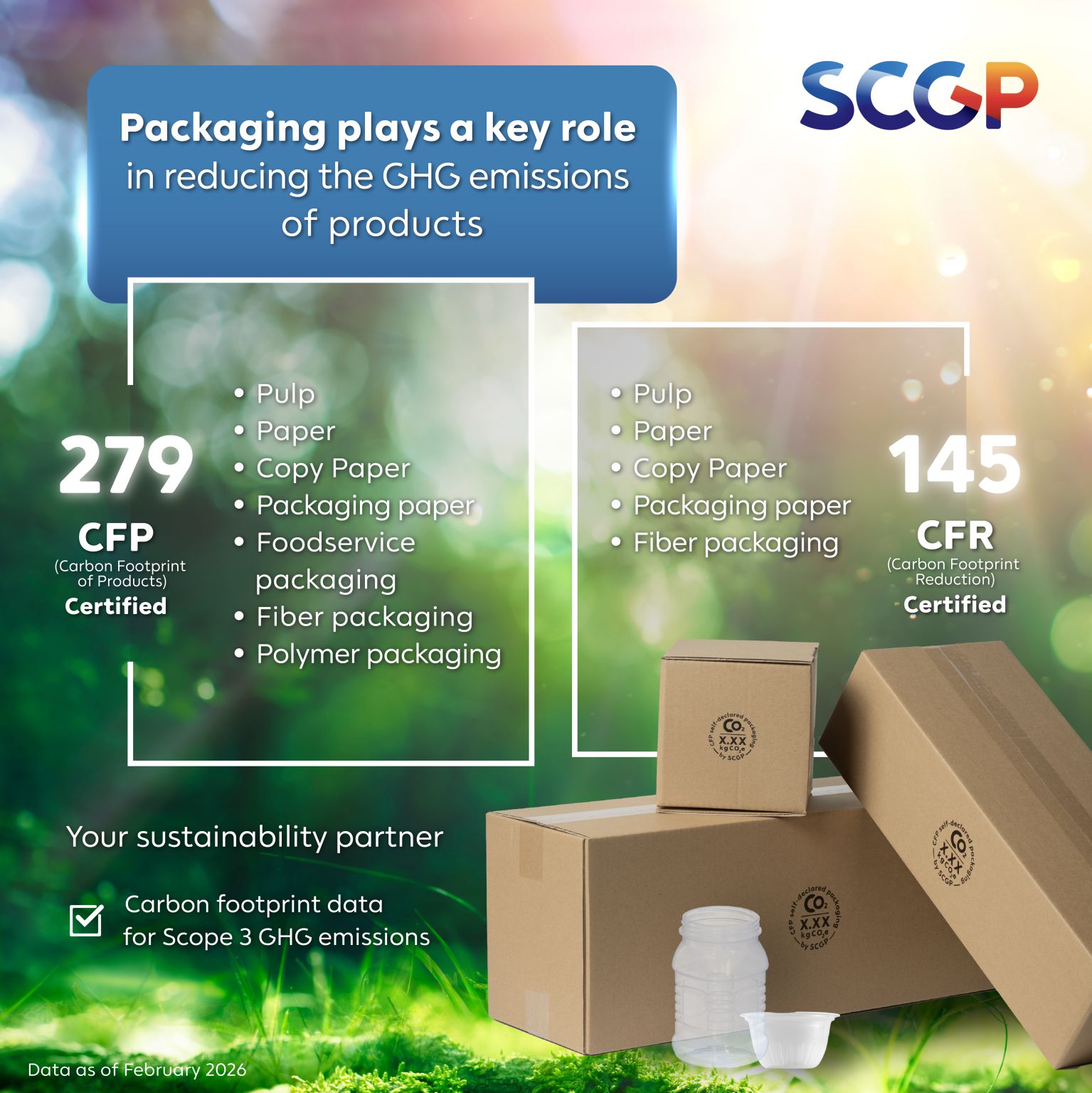
Packaging plays a key role in reducing the greenhouse gas (GHG) emissions of products.
A product’s carbon footprint does not arise from the product alone; rather, greenhouse gas emissions are generated across the entire life cycle – from raw material sourcing through manufacturing, packaging, transportation, usage, and end-of-life management. This makes packaging a critical contributor to greenhouse gas emissions throughout the product life cycle.
As SCGP advances toward Net Zero, we continuously reduce emissions across our operations — from raw materials and energy use to environmentally friendly product development. This approach enables us to systematically develop carbon footprint data for packaging, allowing customers to apply this data directly to their Scope 3 greenhouse gas emissions and the carbon footprint of their products.
Many SCGP products are certified with Carbon Footprint of Products (CFP) and have been further improved to achieve Carbon Footprint Reduction (CFR), officially registered by the Thailand Greenhouse Gas Management Organization (TGO). These certifications provide verifiable evidence of carbon footprint of products.
This turns packaging into a practical tool for ESG reporting and sustainability communication — and increasingly, a key consideration for international markets. Evolving environmental regulations in Europe and rising green procurement standards are making carbon footprint data an essential part of global trade.
Today, SCGP has 279 CFP-certified and 145 CFR-registered products in Thailand, covering pulp, paper, copy paper, foodservice packaging, packaging paper, and plastic packaging. This goes beyond materials. It provides carbon footprint data that customers can apply across their value chain.
This is how SCGP supports customers as a Sustainability Partner in moving toward a more sustainable future.
#SCGP #SCGPESG #ESG #Carbonfootprint #Sustainable #packagingsolutions #sustainablepackaging #SCGPackaging